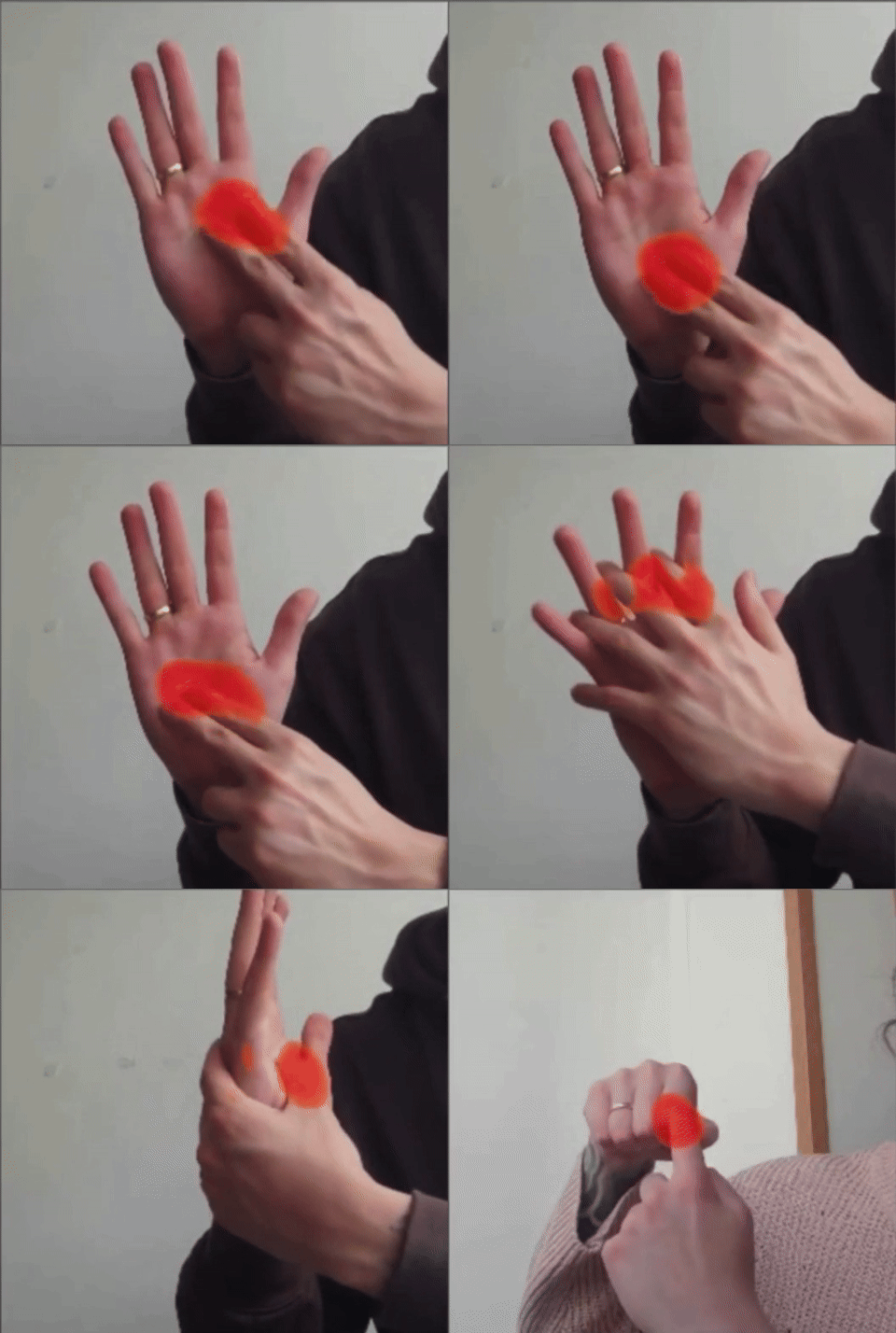
Hand tracking is a growing research field that can potentially provide a natural interface to interact with virtual environments. However, despite the impressive recent advances, the 3D tracking of two interacting hands from RGB video remains an open problem. While current methods are able to infer the 3D pose of two hands in interaction reasonably, residual errors in depth, shape, and pose estimation prevent the accurate detection of hand-to-hand contact. To mitigate these errors, in this paper, we propose an image-based data-driven method to estimate the contact in hand-to-hand interactions. Our method is built on top of 3D hand trackers that predict the articulated pose of two hands, enriching them with camera-space probability maps of contact points. To train our method, we first feed motion capture data of interacting hands into a physics-based hand simulator, and compute dense 3D contact points. We then render such contact maps from various viewpoints and create a dataset of pairs of pixel-to-surface hand images and their corresponding contact labels. Finally, we train an image-to-image network that learns to translate pixel-to-surface correspondences to contact maps. At inference time, we estimate pixel-to-surface correspondences using state-of-the-art hand tracking and then use our network to predict accurate hand-to-hand contact. We qualitatively and quantitatively validate our method in real-world data and demonstrate that our contact predictions are more accurate than state-of-the-art hand-tracking methods.
Keywords: Computer vision, Hand tracking, Hand interaction
@article{SORLI2025104200,
title = {Accurate hand contact detection from RGB images via image-to-image translation},
journal = {Computers & Graphics},
volume = {128},
pages = {104200},
year = {2025},
issn = {0097-8493},
doi = {https://doi.org/10.1016/j.cag.2025.104200},
url = {https://www.sciencedirect.com/science/article/pii/S009784932500041X},
author = {Suzanne Sorli and Marc Comino-Trinidad and Dan Casas},
keywords = {Computer vision, Hand tracking, Hand interaction},
}
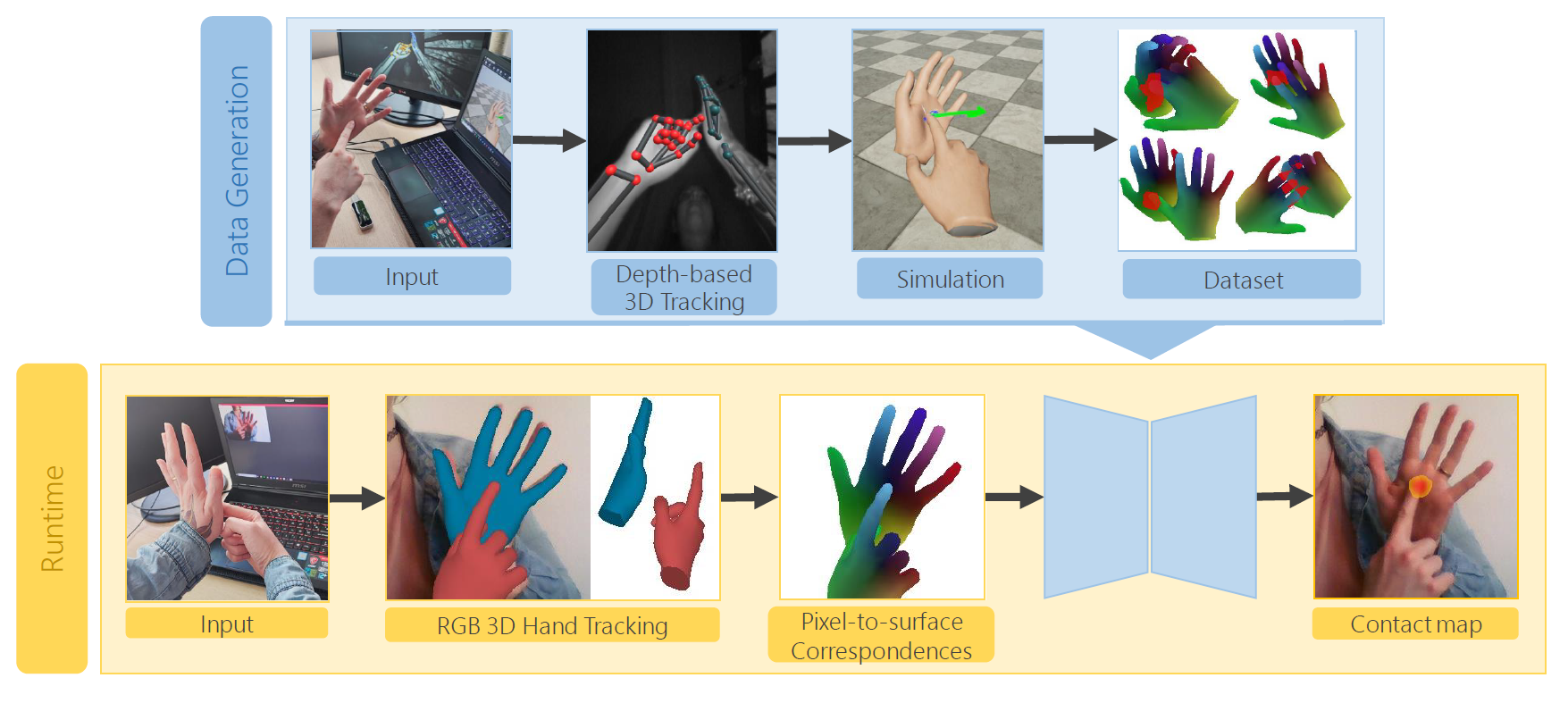
We propose an image-based method to estimate hand-to-hand contacts from a single RGB image. Our method builds on top of existing two-hand tracking solutions, enriching them with a camera-space probability map of hand contact. We formulate our method as an image-to-image translation problem. Assuming a single RGB image as input, we first estimate pixel-to-surface correspondences [13] through a state-of-the-art 3D hand tracking method [9]. We then use a UNet architecture to translate the pixel-to-surface image into a probability contact map image.
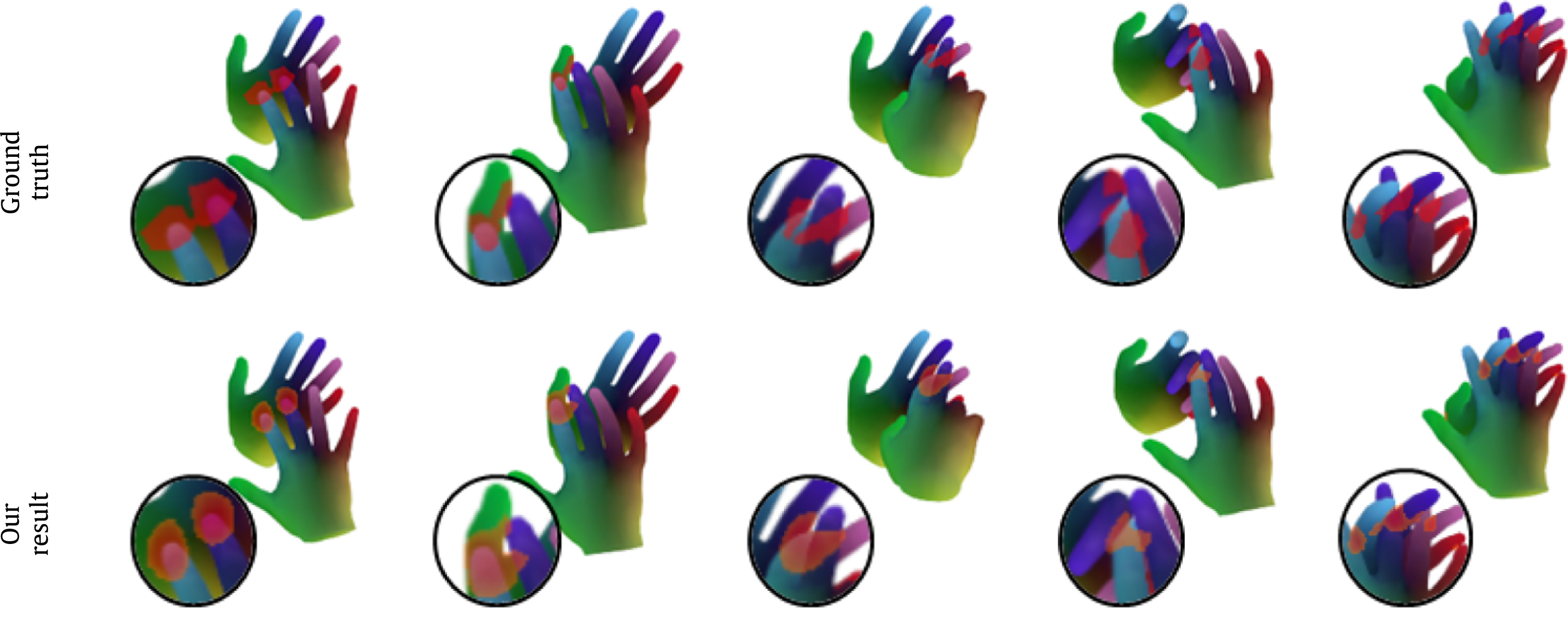
To train our method, we propose a new pipeline to automatically annotate dense surface contacts in hand interaction sequences. To this end, we first use a commercial depth-based hand tracker to capture a collection of hand interaction sequences. We then fit a parametric surface hand model [14], and feed the resulting hand mesh sequences into a physics-based simulator [15]. This allows us to automatically detect and annotate per-vertex collisions, which we use to render ground truth contact maps for a variety of viewpoints. Additionally, for each frame, we also render ground truth pixel-to-surface correspondences automatically provided through the UV parameterization of the hand mesh. Finally, using a large dataset of pairs of pixel-to-surface images and contact maps, we train our UNet network.
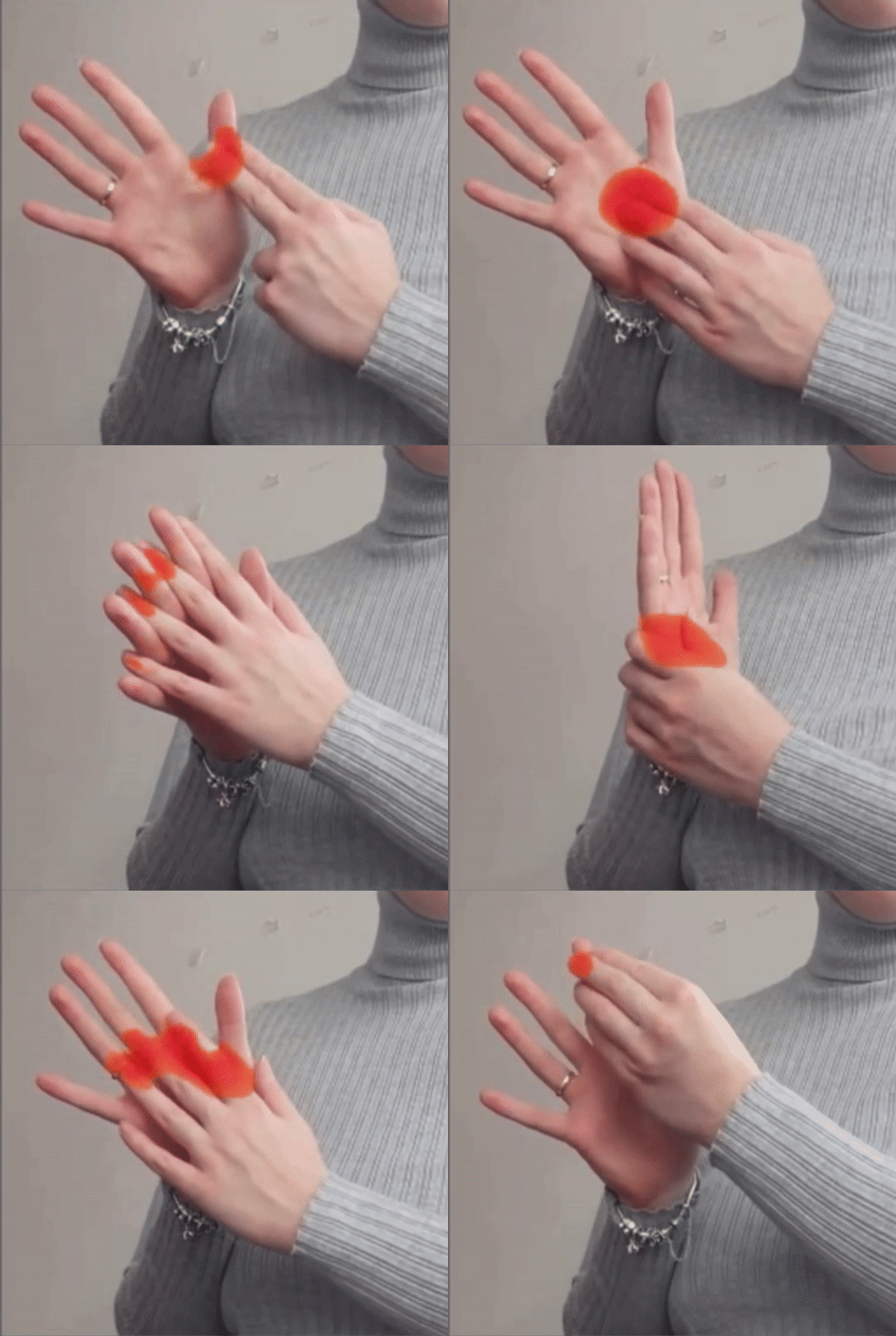
We qualitatively and quantitatively evaluate our method in both synthetic scenes and real scenes. For each scene, we compare the detected two-hands contact using our method and the state-of-the-art method of Li et al. [9]. We also implement a straightforward RGB-only baseline consisting of a UNet network that directly predicts camera space contacts from RGB (i.e., without using pixel-to-surface estimation).
Our estimated contacts consistently achieve higher F1 scores than raw tracking systems in both synthetic and real scenes. Consequently, we can accurately estimate contact even when the underlying tracking fails. A key benefit of our method is that it is designed as a standalone component, not limited to a specific input sensor or modality. Since our network takes rendered pixel-to-surface correspondences as input, our method circumvents many challenges common in real-world images, such as illumination, sensor noise, or shadows.
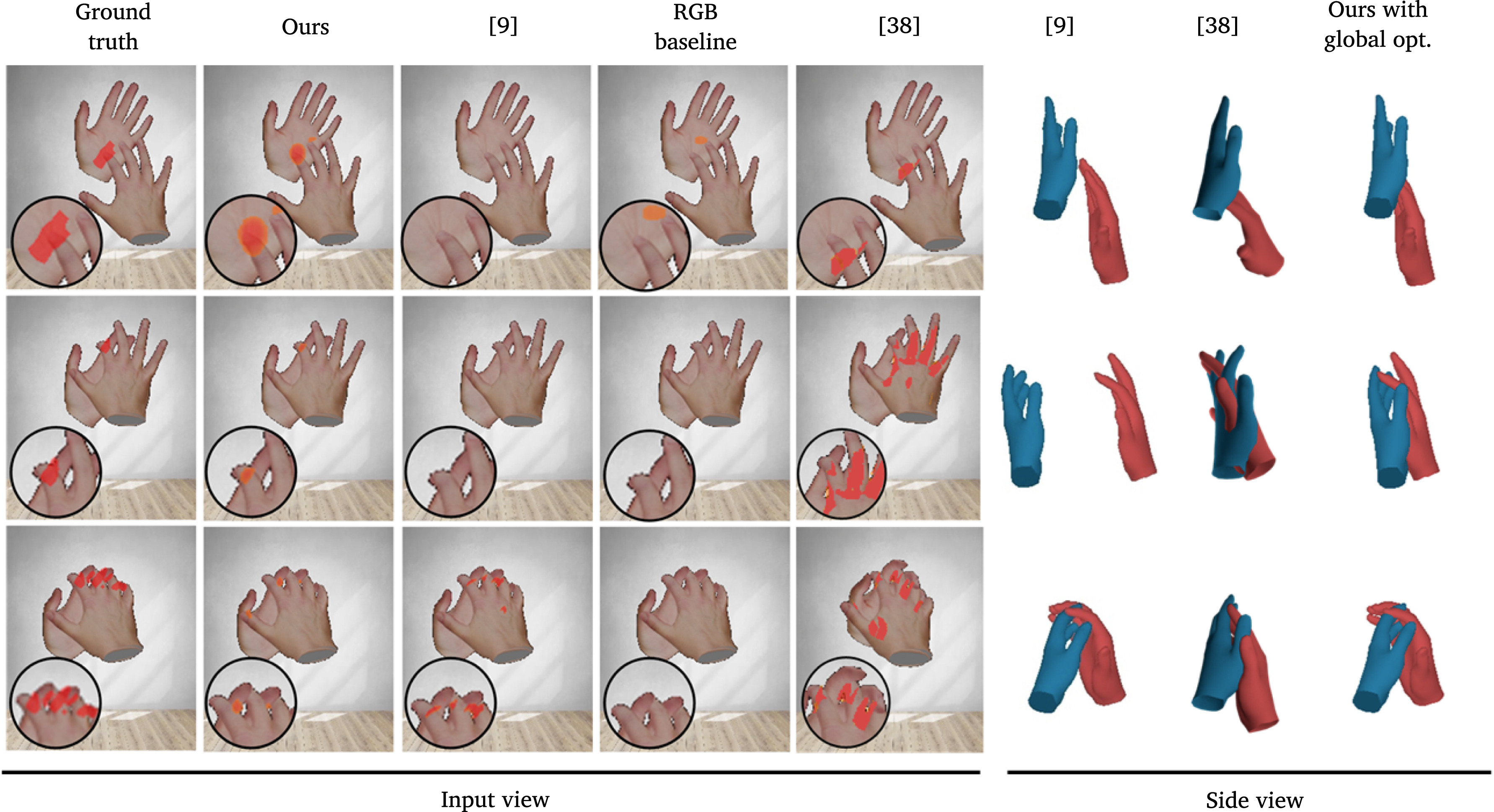
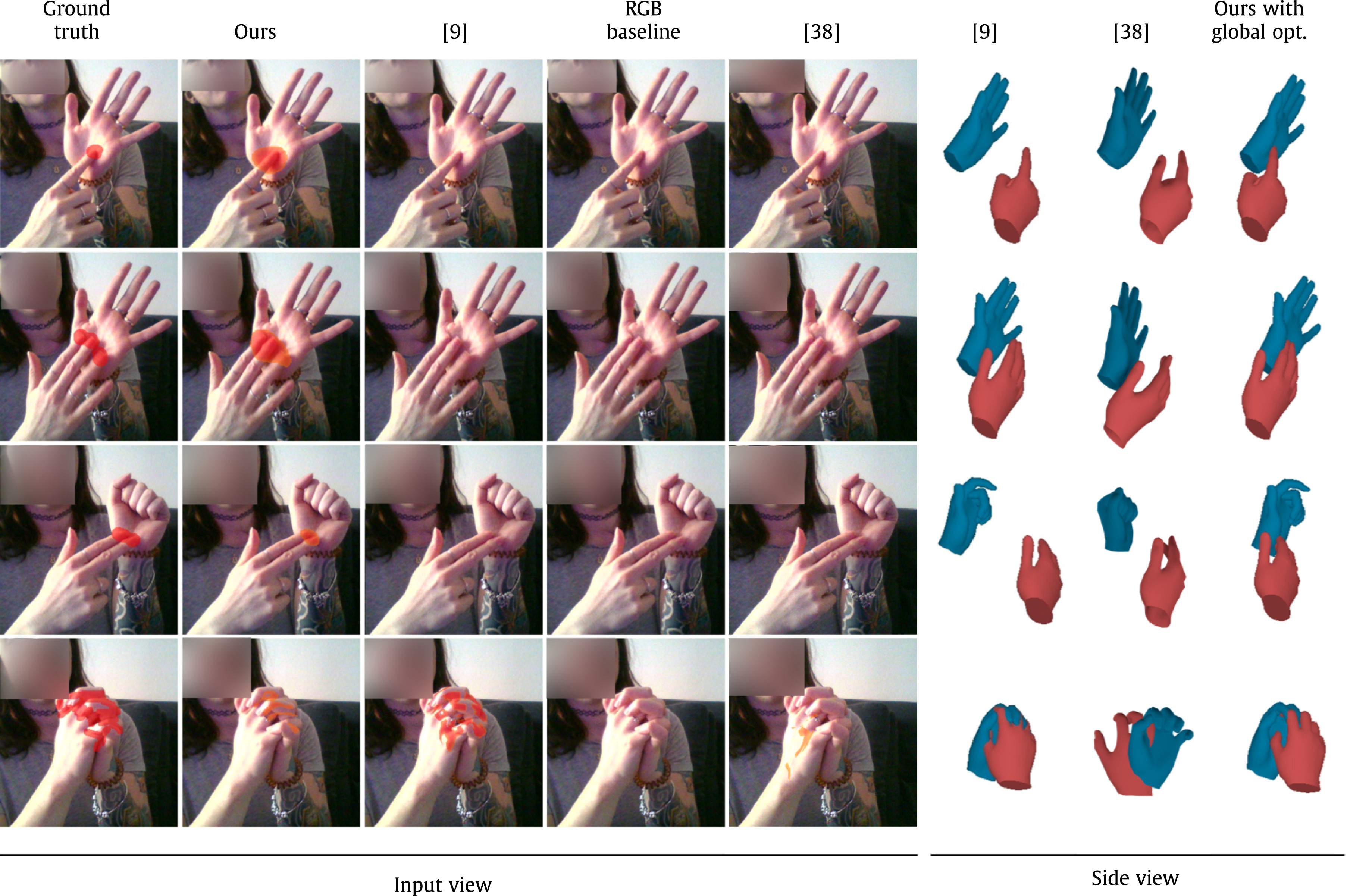
Our inferred contact maps open the door to many downstream tasks in the area of hand tracking and human–computer interaction, where detecting accurate contact is crucial. To showcase a potential approach, we have used inferred maps to improve the accuracy of state-of-the-art 3D hand tracking methods with respect to 3D contact detection. To this end, starting from the 3D hand poses estimated with Li et al. [9], we optimize the global 3D position (e.g., 3 DOFs) of the hand closest to the camera such that the vertices within the areas where contact is detected (in camera space) are in contact in 3D space. This effectively refines the hand positions estimated with state-of-the-art methods, estimating 3D hand poses that are in actual contact.
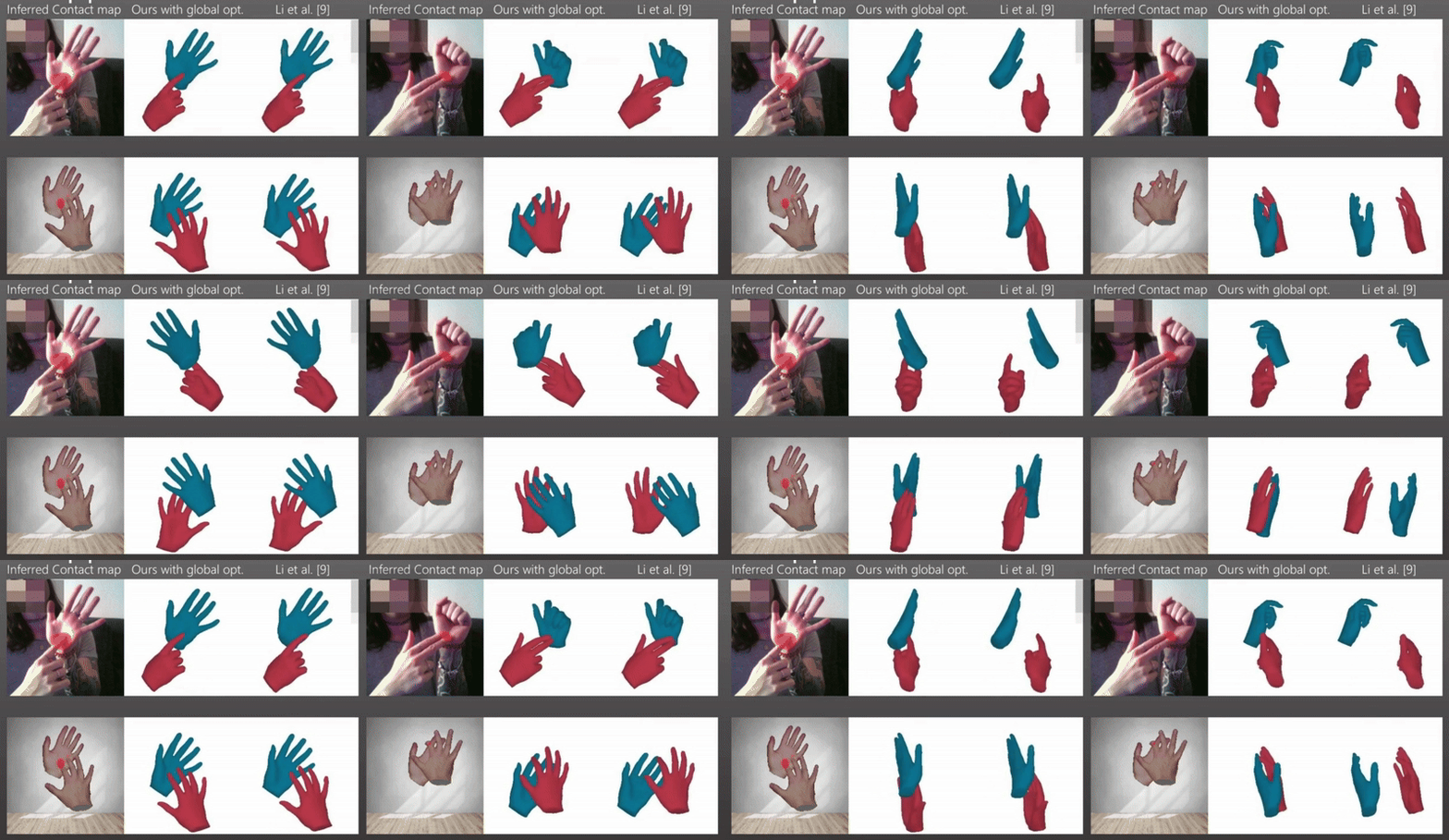
At inference time, we can use any commercial RGB camera to capture sequences of an individual performing interactions with his or her hands. To provide an initial estimation of the hand tracking, we can use any state-of-the-art method for simultaneous two-hand tracking on the frames from the input sequences (e.g. [9]), and then convert the tracked sequences to MANO [14] representation. We render the corresponding hand meshes, from the same camera viewpoint, using a texture that encodes the surface-to-pixel color-coded correspondences. The rendered images are fed into the trained network which yields the desired contact maps.