Fast Voxelization and Level of Detail for Microgeometry Rendering
Javier Fabre,
Carlos Castillo,
Carlos Rodriguez-Pardo
and Jorge Lopez-Moreno
The Visual Computer, 2026
Many materials show anisotropic light scattering patterns due to the shape and local alignment of their underlying micro structures: surfaces with small elements such as fibers, or the ridges of a brushed metal, are very sparse and require a high spatial resolution to be properly represented as a volume. The acquisition of voxel data from such objects is a time and memory-intensive task, and most rendering approaches require an additional Level-of-Detail (LoD) data structure to aggregate the visual appearance, as observed from multiple distances, in order to reduce the number of samples computed per pixel (E.g.: MIP mapping). In this work we introduce first, an efficient parallel voxelization method designed to facilitate fast data aggregation at multiple resolution levels, and second, a novel representation based on hierarchical SGGX clustering that provides better accuracy than baseline methods. We validate our approach with a CUDA-based implementation of the voxelizer, tested both on triangle meshes and volumetric fabrics modeled with explicit fibers. Finally, we show the results generated with a path tracer based on the proposed LoD rendering model.
@article{Fabre:2026:FastVoxelization,
  author    = {Fabre, Javier and Castillo, Carlos and Rodriguez-Pardo, Carlos and Lopez-Moreno, Jorge},
  title     = {Fast Voxelization and Level of Detail for Microgeometry Rendering},
  journal   = {The Visual Computer},
  year      = {2026},
  publisher = {Springer}
}
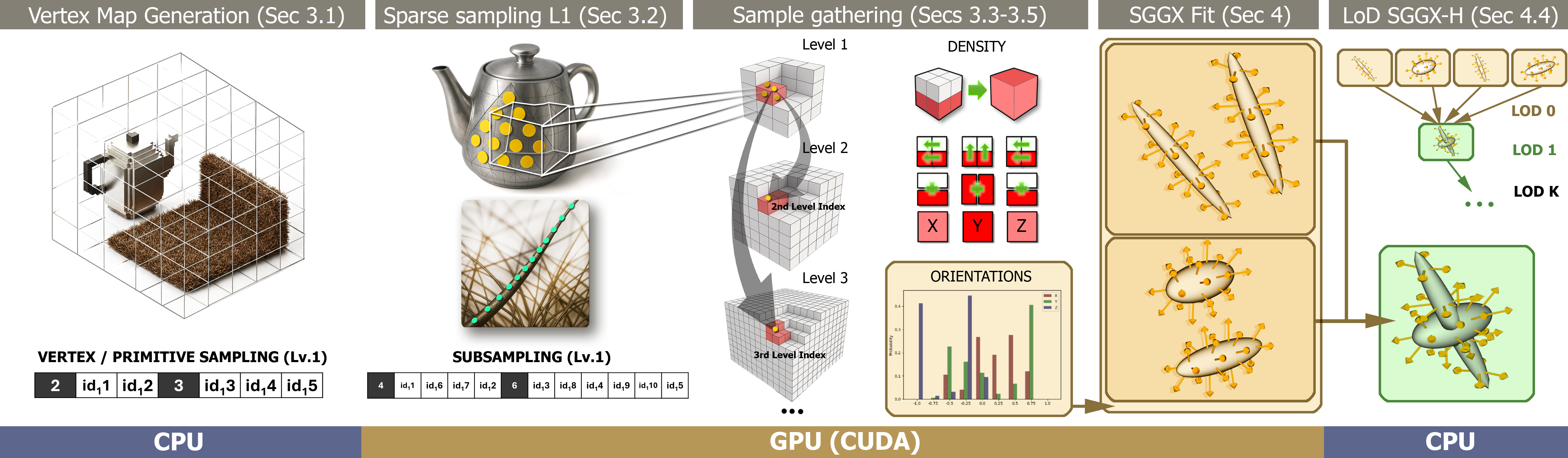
We present a GPU-based method to efficiently render complex microgeometry using a hierarchical voxel representation. Each voxel encodes a directional microflake distribution (SGGX), allowing accurate modeling of anisotropic materials beyond simple density-based approaches.
Our method performs fast parallel voxelization and builds a multi-resolution hierarchy by aggregating statistical distributions instead of averaging values, preserving appearance across scales. The hierarchical process merges closests SGGX functions to reduce the resulting error (Jensen-Shannon divergence from GT):
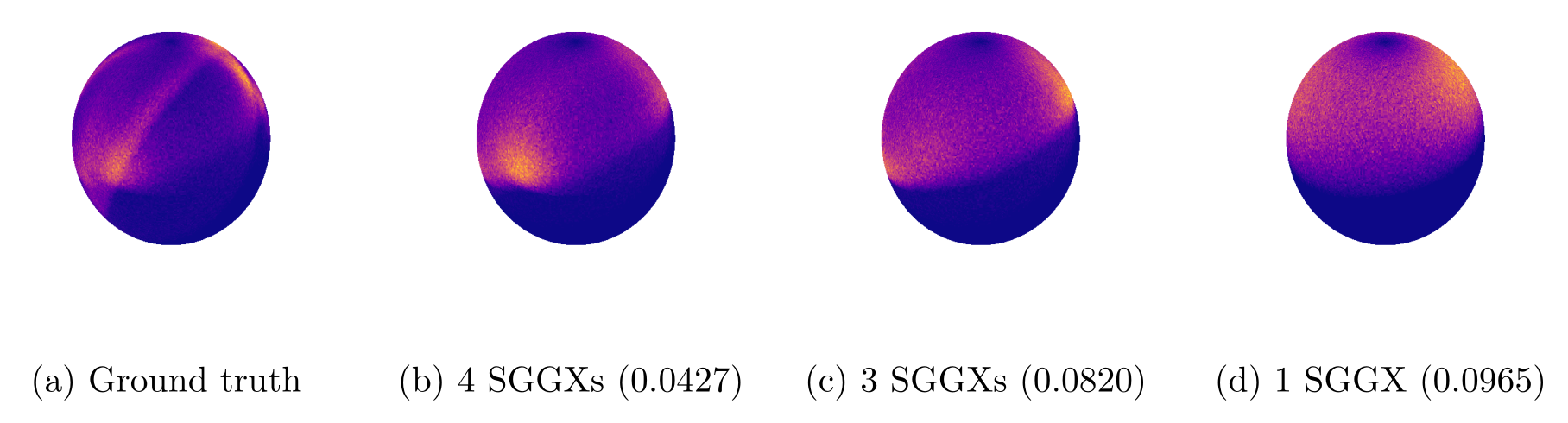
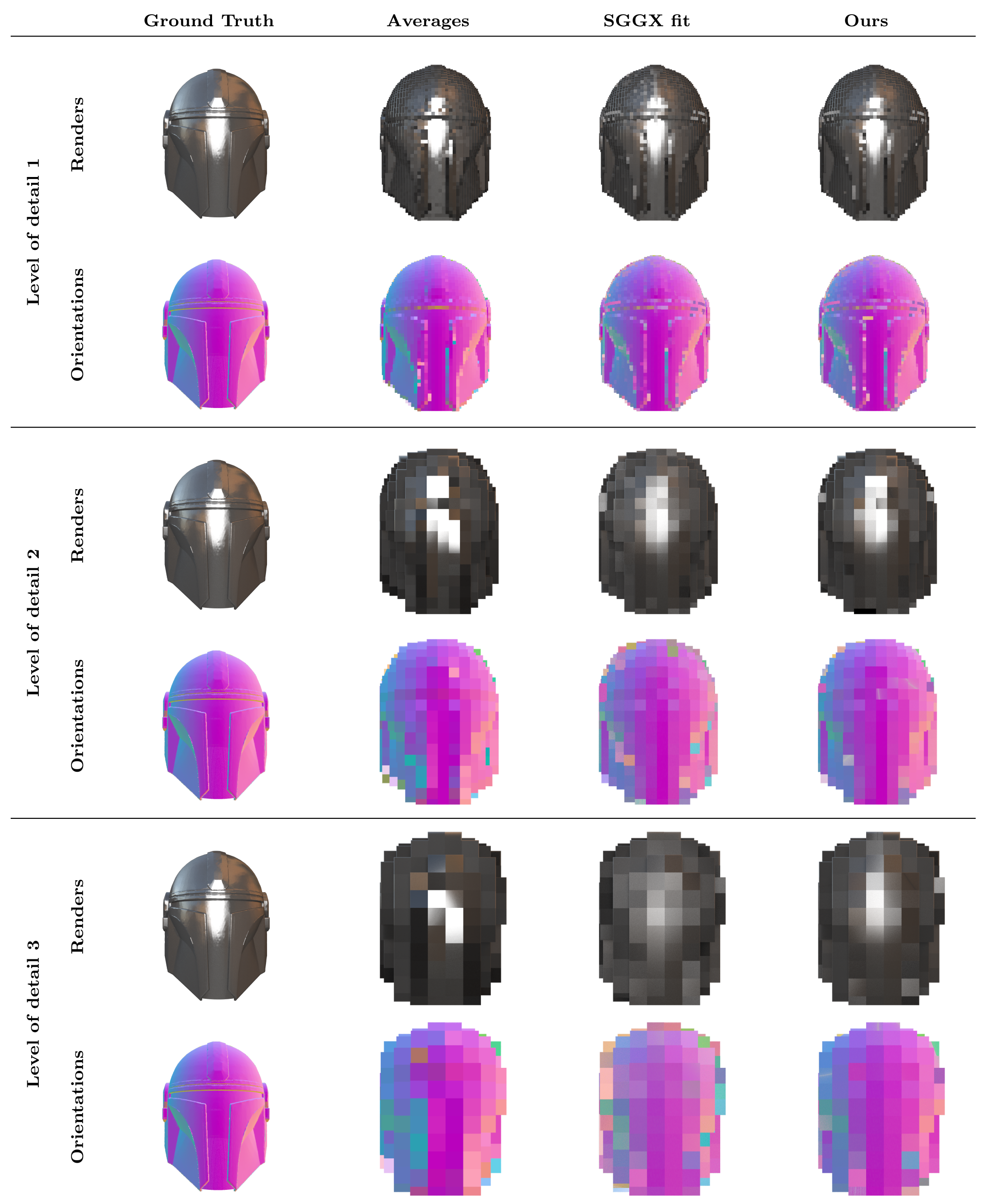
Our representation preserves directional detail that is lost in traditional voxel methods. As shown below, SGGX-based voxels preserve anisotropy, producing more accurate results than traditional approaches.
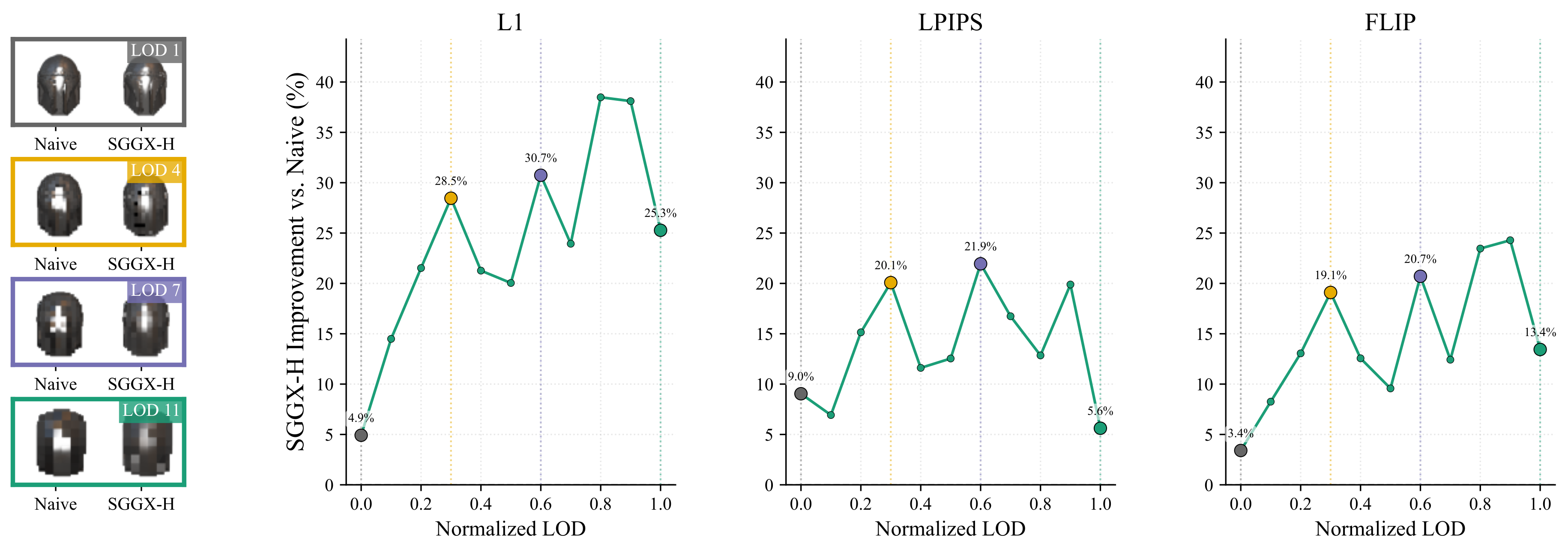
Different levels of detail can be used depending on distance, reducing cost while keeping the material's appearance consistent.