We present a method to augment parametric skeletal models with subspace soft-tissue deformations. We combine the benefitsof data-driven skeletal models, i.e., accurate replication of contact-free static deformations, with the benefits of pure physics-based models, i.e., skin and skeletal reaction to contact and inertial motion with two-way coupling. We succeed to do so in ahighly efficient manner, thanks to a careful choice of reduced model for the subspace deformation. With our method, it is easyto design expressive reduced models with efficient yet accurate force computations, without the need for training deformationexamples. We demonstrate the application of our method to parametric models of human bodies, SMPL, and hands, MANO,with interactive simulations of contact with nonlinear soft-tissue deformation and skeletal response.
@article{tapia2021parametric,
	title      = "Parametric Skeletons with Reduced Soft-Tissue Deformations",
	author     = "Tapia, Javier and  Romero, Cristian and Pérez, Jesús and Otaduy, Miguel A",
	booktitle  = "Computer Graphics Forum",
	year       = "2021",
	url        = "http://mslab.es/projects/PSfSTD/"
}
Data-driven and physics-based methods offer competing features for the animation of skeletal figures such as human bodies or hands. Data-driven methods are very fast and reproduce with high accuracy contact-free static poses. However, they do not exhibit soft-tissue deformations and skeletal reaction due to contact or inertial effects. Physics-based methods, on the other hand, are reactive and exhibit detailed soft-tissue deformations with potentially two-way coupled skeletal motion.
Subspace simulation methods provide a fast way to approximate soft-tissue deformations. They build a reduced kinematic basis, while evaluating the deformation of the complete high-resolution mesh.
We present a model of reduced kinematics that combines a data-driven skeletal model and a skinning-based subspace method. For the successful conservation of accurate data-driven deformations, we build the subspace basis and formulate dynamics in the unposed reference shape. The resulting model produces effective skeletal dynamics and data-driven pose-space global static deformation, enriched with local subspace soft-tissue deformations.
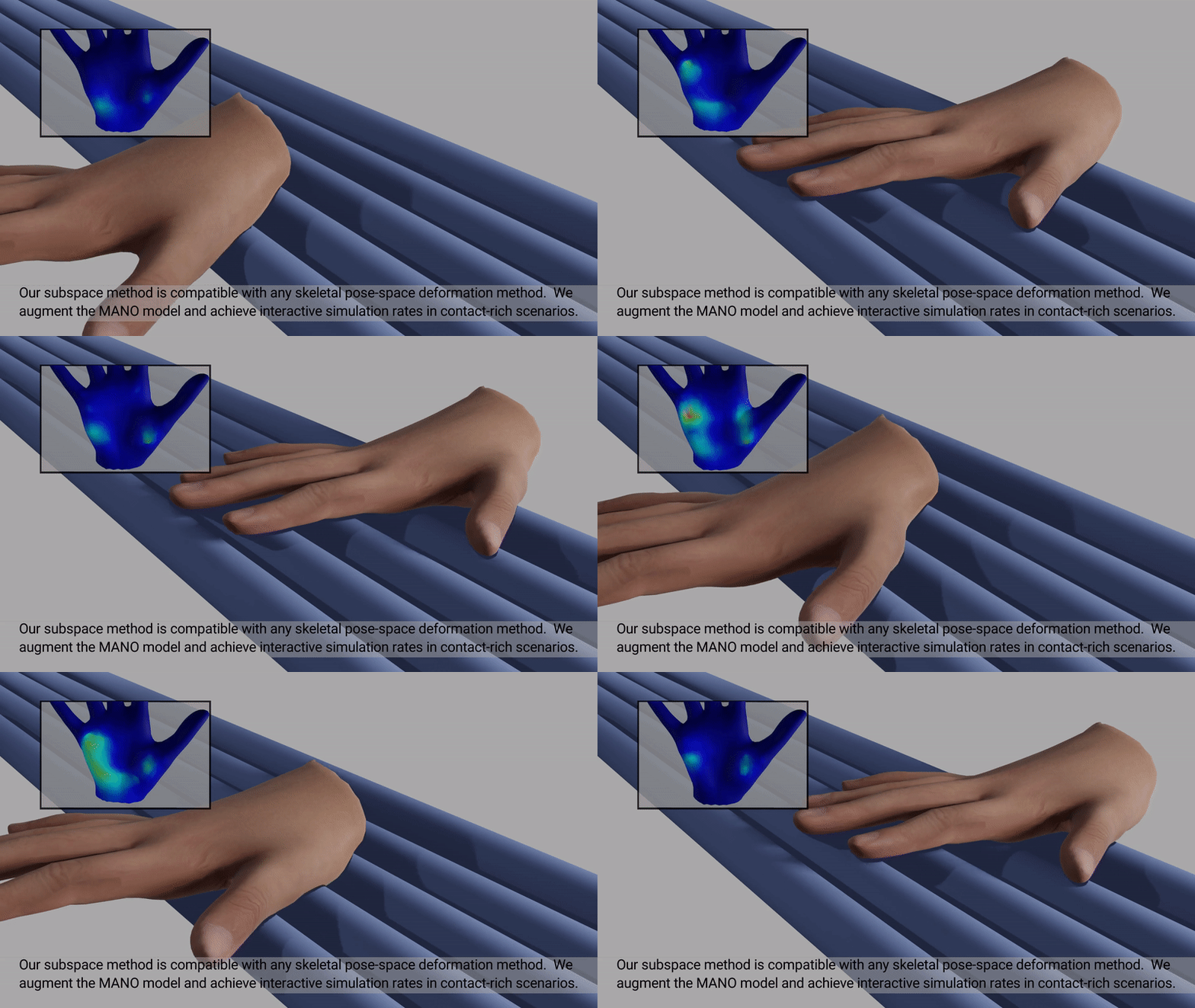
We have applied our deformation method to augment the SMPL body model and the MANO hand model with interactive, nonlinear soft-tissue deformations. We set up demonstration examples controlled by either scripted character animations or interactive hand tracking, with two-way coupling of skeletal response and soft-tissue deformation under contact scenarios.

The resulting method features realistic dynamics, highly non-linear materials, and two-way coupling between flesh and bones through frictional contact and inertia. While any other PSD could be potentially used, our method gets the most from parametric models. As global static deformations are handled by the data-driven pose blend shapes, the subspace basis is completely devoted to representing local deformations.
The MANO model represents the hand as a template triangle mesh. Static skin deformations are parameterized through shape and pose parameters. Shape parameters are kept constant during simulation and allow to personalize the hand model for different users. We optimized shape parameters to fit a real hand model of an adult male of 50th percentile height and weight obtained using CT and MRI data.
We build our subspace basis by manually distributing handle points throughout the palm of the hand, where the main contact interaction is expected to happen.
The SMPL model is defined analogously to the MANO model. We manually sample handle points uniformly distributed throughout the surface of the body.

Our method enjoys important practical benefits, as it allows easy design of a subspace basis and a subspace integration method without the need for deformation examples.
