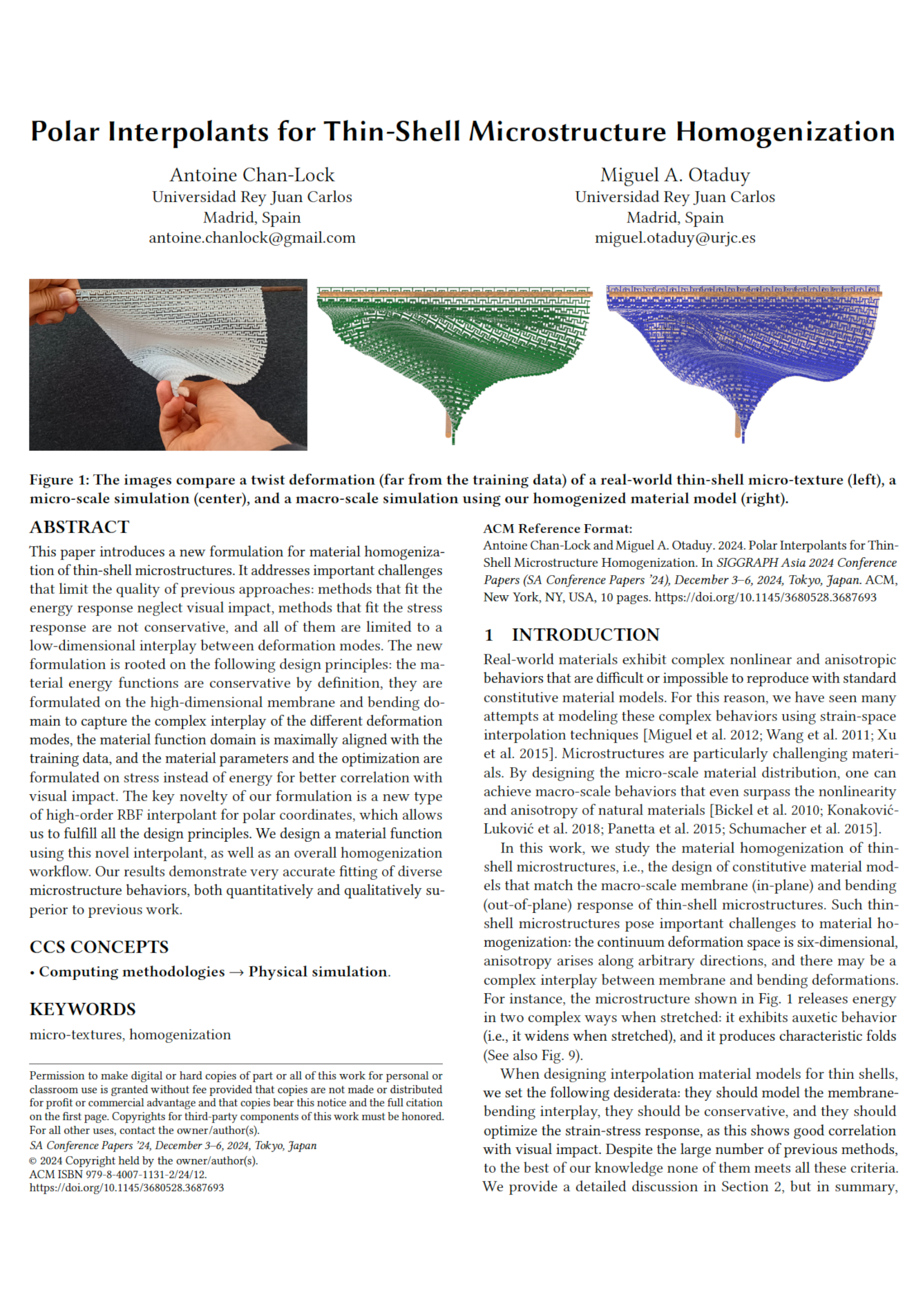
This paper introduces a new formulation for material homogenization of thin-shell microstructures. It addresses important challenges that limit the quality of previous approaches: methods that fit the energy response neglect visual impact, methods that fit the stress response are not conservative, and all of them are limited to a low-dimensional interplay between deformation modes. The new formulation is rooted on the following design principles: the material energy functions are conservative by definition, they are formulated on the high-dimensional membrane and bending domain to capture the complex interplay of the different deformation modes, the material function domain is maximally aligned with the training data, and the material parameters and the optimization are formulated on stress instead of energy for better correlation with visual impact. The key novelty of our formulation is a new type of high-order RBF interpolant for polar coordinates, which allows us to fulfill all the design principles. We design a material function using this novel interpolant, as well as an overall homogenization workflow. Our results demonstrate very accurate fitting of diverse microstructure behaviors, both quantitatively and qualitatively superior to previous work.
@article{PolarInterpolants,
	author    = {Chan-Lock, Antoine and Otaduy, Miguel A.},
	title     = {Polar Interpolants for Thin-Shell Microstructure Homogenization},
	journal   = {SIGGRAPH Asia Conference Papers (SA Conference Papers ’24)},
	year      = {2024}
}
In this paper, we introduce a new formulation for homogenizing thin-shell microstructures using polar interpolants, addressing challenges related to energy conservativeness, visual deformation impact, and complex deformation interactions. The contributions of our work are: